
Technology & Art
Lost Wax Casting of Jewelry and Statues
by Gary Baker, Esq. — Patent Attorney
Manufacturing silver jewelry and art objects is satisfying. I can exercise a variety of skills and everyone recognizes the value, if not the art, of the final product.
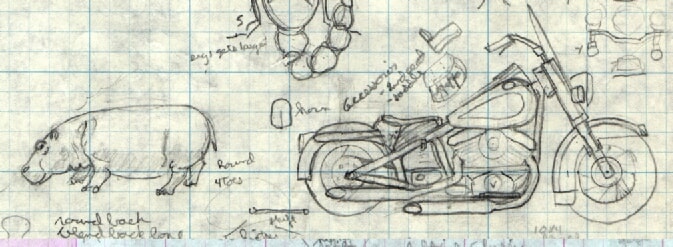
To make a silver statue, one must sketch a design in multiple perspectives, fabricate a wax model original, produce a mold, cast molten silver into the mold, polish and assemble the object. The result is a permanent expression of art with the gleam and romance of the most reflective precious metal. I also find the weight, rapid heat conductivity and smooth contours of silver statuettes can fascinate the sense of touch.
A Day in Nepal I Learned About Soldering Silver
I was inspired to become a silver worker after I spent a day having a craftsman in Nepal fabricate a traditional silver ring. We sat on the dirt floor of his small shop where he used simple tools to assemble the appliqué ring starting from a bar of silver bullion. He flattened the silver bar into a sheet on an anvil with a hammer. He sketched a flat band on the sheet silver and cut it out with a very fine jeweler's saw blade. The flat band was wrapped around a stick the size of my finger, cut to size and the ends sealed together with silver solder.
He didn't have a modern solder torch but a can of kerosene with a wick and a blow pipe attached. A puff of his breath across the wick sent a yellow-orange reducing flame onto the work piece to melt the solder. He fabricated a smaller silver band as a bezel mount that could be pressed in to hold a star ruby. Small pieces of scrap silver were melted like mercury into little liquid silver balls. The plain silver ring was decorated with the bezel mount band and the silver balls.
The craftsman used a small artist's paint brush to apply liquid silver solder flux between the ring and bezel mount band and silver ball appliqués. Then he used the fine paint brush to carefully place flux-wetted slivers of silver solder to the base of the bezel mount band and each silver ball. When he blew the soft orange flame across the object, the slivers of silver solder liquefied and crept between the ring and bezel mount band and silver ball appliqués. After cooling, the appliqués were permanently frozen to the silver ring.
He placed my cabochon cut star ruby into the bezel mount then pushed the upper walls of the mounting band onto the ruby holding it fast. The ring was hand polished to a high luster on a leather strap coated with jeweler's rouge. In about four hours, the Nepali jeweler had turned a bar of silver into a beautiful ring with only a small set of simple tools. I thought: I can learn to do that — and I have better tools at home.
I constructed jewelry by the appliqué method for many years after I got home. I quit hammering out my sheet stock on an anvil after I bought a rolling mill machine with large steel rollers to do the work. I use a self-lighting propane torch and a soldering stage with metal fingers to hold the pieces together when soldering. But this is a discussion of Lost Wax Casting.
The Six Metal Casting Steps
Lost wax casting is a method originally developed for dentists to make gold and silver crowns. A wax original is covered with plaster — called investment. A mold is created when the wax is vaporized in a very hot oven, leaving a hollow cavity the shape of the wax original. The mold is then injected with molten silver using a centrifuge to force the molten metal into every detail.
Design
Wax Original
Mounting and Investment
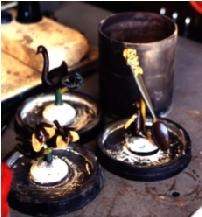 Several objects can be mounted to be cast together on the same wax stock called a sprue. Many objects on a sprue look like branches on a tree trunk. The sprue is planted in a rubber stage that will act as the bottom of a container to hold liquid investment when a steel cylinder is placed around the tree of sprue and objects. Dry powder investment is mixed with water to a consistency like thick pancake batter and poured over the sprue and objects inside the metal cylinder. The filled cylinder is placed in a vacuum chamber and a vacuum pump turned on; the liquid investment boils as air trapped in and on the wax objects is pulled off by the vacuum. The cylinder is placed on a level surface for the investment to harden.
Bake Out
Casting
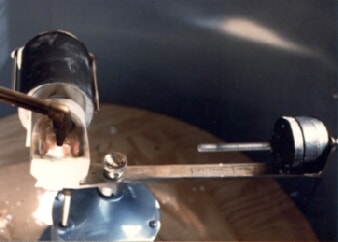 A crucible sits on the arm of a spring powered centrifuge next to a cradle that will hold the baked out mold at the end of the centrifuge arm. The required amount of silver — calculated as 12 times the weight of the wax sprue and objects — is placed into the crucible. The silver is melted with an acetylene torch to cherry red liquid. The baked out mold, at about 1,000 degrees F, is immediately set onto the cradle at the end of the centrifuge arm. My heart is pounding with anticipation of the critical moment. I release the centrifuge arm and the arm spins rapidly. The centrifugal force pushes the liquid silver into the mold cavity filling every detail. After the arm stops spinning, the hot cylinder is quenched in water. The investment dissolves and the silver casting falls out.
Finishing
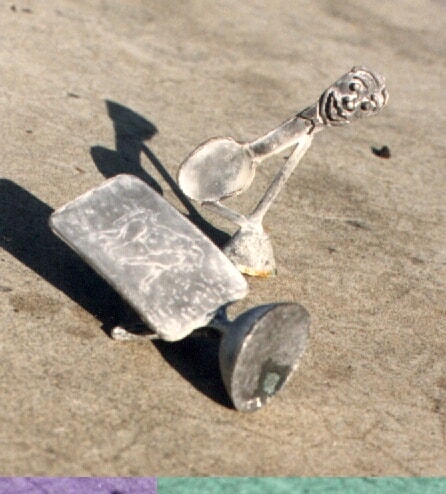 The silver objects are cut from the silver sprue trunk with a jeweler's saw. Rough spots are filed away. I hate finishing. The objects are polished through a never ending series of finer and finer abrasives — emery paper, finer emery paper, coarse polishing compound on a buffing wheel, jeweler's rouge, ultra fine compound. The dust flies. A filtered respirator is required. I polish each object on the buffing wheel until it is too hot to hold in gloved hands. Crevices and delicate details are polished on a leather shoe string coated with jeweler's rouge. Brighter and shinier. Finally, done. I love to sit back and admire the little statues sitting on black velvet — a shining baby spoon, belt buckle or a gleaming Harley-Davidson with tunable front wheel.
Also see an example of ancient lost wax technique for five metal statues.